How to Migrate Your Rental Software Without Disrupting Your Business
Switching rental software can feel like a big decision, especially when your current system is still working day to day.
In most cases, it’s not something businesses plan for in advance: it becomes a consideration gradually, as small inefficiencies start to build and the business begins to outgrow its current setup.
Things might slow down slightly. Workarounds start to appear. Teams begin relying on manual processes to fill the gaps. Information becomes slightly harder to trust at a glance.
And because nothing is fully broken, it often gets pushed down the list, until it can’t be ignored anymore.
In this article, we’ll share our perspective on what causes that tipping point, and what a smooth transition actually looks like in practice once you make the decision to switch rental software.
Table of contents
- How do you know when rental software is no longer fit for your business?
- Why do companies delay switching rental software even when they’re struggling?
- What does a successful rental software switch look like in practice?
- What does this look like in real rental businesses?
- How does HireHop handle switching rental software?
How do you know when rental software is no longer fit for your business?
It’s rarely one obvious issue that drives the decision to switch. More often, it’s a collection of smaller friction points that build up over time.
Common signs include:
- Jobs taking longer to process or load than expected
- Teams relying on spreadsheets or manual workarounds
- Data that needs to be double-checked before decisions are made
- Reporting that doesn’t give a clear or real-time view of the business
- Difficulty managing increased complexity as the business grows
Individually, these issues can feel manageable. But together, they often signal that the system is no longer fully aligned with how the business operates.
A useful way to think about it is this: most software doesn’t fail suddenly, it simply stops keeping up.
Quick checklist:
- Are jobs taking longer than they should?
- Are workarounds becoming part of daily operations?
- Do you double-check data before making decisions?
- Is visibility across teams limited?
- Is your system struggling as you grow?
Why do companies delay switching rental software even when they’re struggling?
Even when inefficiencies are clear, switching systems can feel like a major undertaking.
The more common ones we see are:
- The current system is still “good enough”
- There is concern about disruption to day-to-day operations
- The switching process feels time-consuming or risky
- Internal teams are already stretched, making change feel harder to prioritise
Because of this, many businesses delay the decision until something forces it.
That might be a system limitation, an operational issue, or simply the pressure that comes with growth.
At that point, it’s not about whether change is needed, but how quickly it can be done.
What does a successful rental software switch look like?
A smooth transition is rarely about the software alone, and usually comes down to how the process is handled.
The most successful switches follow a similar pattern: there’s a bit more thought upfront, a bit more structure behind the scenes, and a clear focus on making sure the system works in practice, not just in theory.
A few things tend to make the biggest difference:
Clean, structured data
Instead of moving everything across as-is, time is spent making sure the data being migrated is accurate, relevant and easy to work with from day one.
Reviewing processes before going live
Switching systems creates a natural opportunity to step back and look at how things are currently done. In many cases, small adjustments here can remove a lot of friction later.
Bringing the team in early
When the people using the system day to day are involved early on, adoption tends to feel much more natural. It’s not just a new tool being introduced, it’s something they understand and feel confident using.
A lot of the challenges people associate with switching software don’t come from the system itself. They come from trying to rush the process or replicate everything exactly as it is, without taking the opportunity to improve it.
What does this look like in real rental businesses?
We’ve seen this pattern across rental companies of different sizes, particularly those transitioning from legacy systems as they scale.
One example is a business working primarily with insurance providers to deliver temporary facilities such as kitchens, bathrooms and storage for policyholders affected by property damage.
Their operation is highly coordinated, involving scheduling, logistics, site work and ongoing communication across teams.
As they grew, their previous system began to feel restrictive. Information wasn’t flowing cleanly between scheduling and operational notes, and visibility across teams became harder to maintain. Over time, this created inefficiencies, duplicated effort and reduced confidence in the system.
They migrated to HireHop in 2022 with around 40 users, moving from a legacy system that had become difficult to scale with.
The transition was described as smooth and straightforward, with the system being easy for teams to adopt, including new starters joining the business.
What changed after switching?
Once live on HireHop, the biggest shift wasn’t just speed, but also visibility and coordination across the business.
Instead of information sitting in separate places, everything was centralised in one system. Any team member could quickly understand the status of a job by reviewing notes, updates, and activity history.
This was especially valuable for field teams, who could upload photos, access site-specific information and add real-time updates directly from site.
It also improved internal communication: office teams were able to respond to queries more quickly because all relevant information was available in one place.
What operational impact did this have?
Beyond day-to-day efficiency, the new system also supported more structured reporting for insurance clients.
HireHop was configured to generate bespoke reports covering orders, deliveries, collections and associated costs. These reports were used both for client reporting and to demonstrate cost efficiencies compared to alternative accommodation options such as hotels.
This became a valuable part of their conversations with insurance partners.
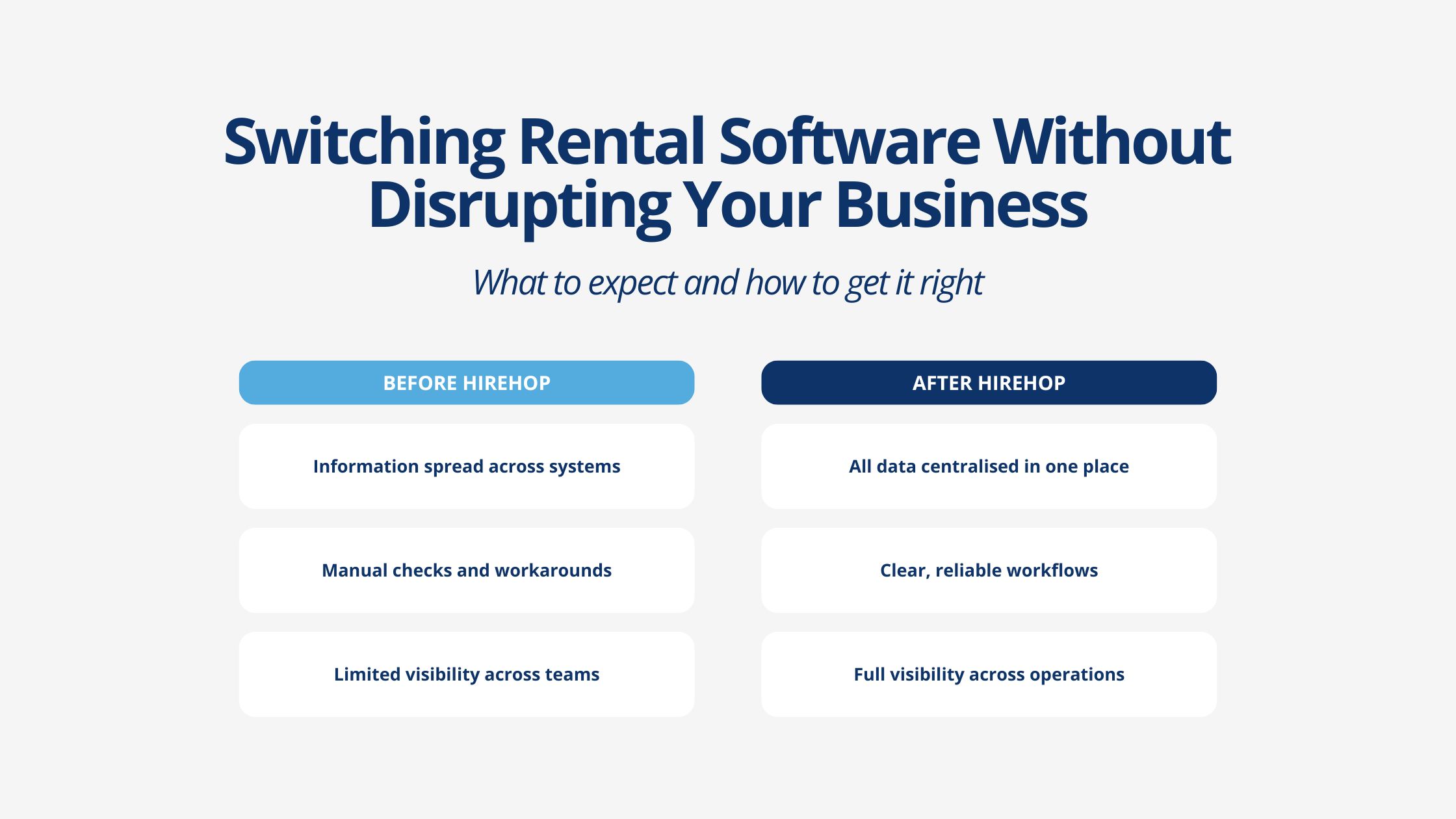
| Before HireHop | After HireHop |
| Information spread across systems | All data centralised in one place |
| Manual checks and workarounds | Clear, reliable workflows |
| Limited visibility across teams | Full visibility across operations |
How does HireHop handle switching rental software?
At HireHop, we focus on making the transition as structured and low-disruption as possible.
We’ve supported hundreds of rental businesses through this process over the years, migrating users from a wide range of legacy systems and providers. In most cases, we’re able to help businesses transition from almost any existing setup.
That experience shapes how we approach onboarding.
It typically includes:
- Supporting data migration to ensure a clean and usable setup from day one
- Helping teams understand the system through real operational scenarios
- Providing hands-on support during onboarding and go-live
We also continue to invest in migration tools to make this process faster and more efficient over time.
Our aim isn’t just to move you onto a new system, but also to make sure it actually fits how your business runs and feels straightforward for the team using it day to day.
Final thoughts
Switching rental software is rarely about reacting to failure: it’s usually about recognising when a system is no longer keeping up with how the business has evolved.
If you are starting to feel that friction, it can be useful to understand what a more modern setup would look like in practice, even if you are not ready to make a change yet.
At HireHop, we are always happy to talk things through, whether that is a full walkthrough, a demo, or simply answering questions about your current setup. Click here to contact our friendly support team now.